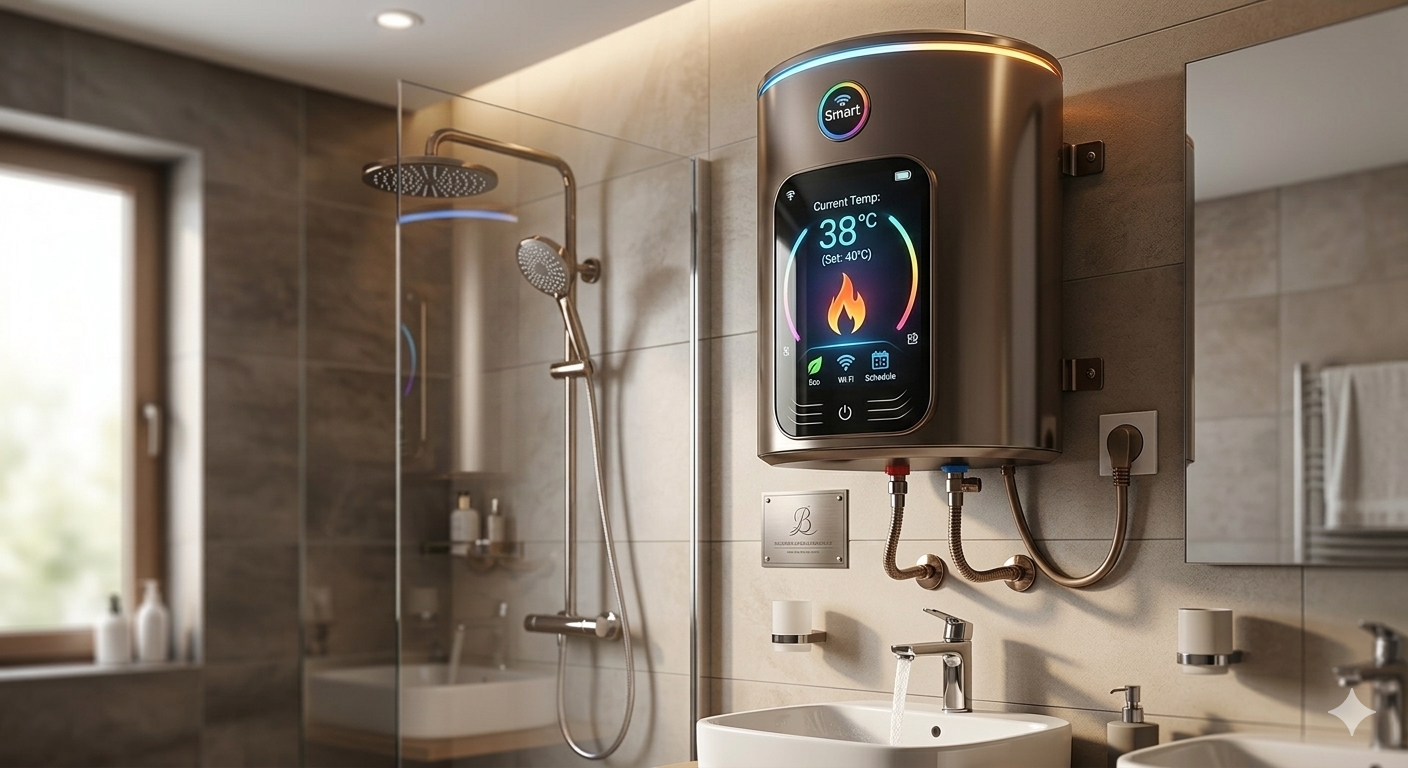
In our previous look at water heaters, we discussed the jump from capacity to smart interfaces. But in 2026, the technology has moved even further. We aren’t just talking about “smart” anymore—we are talking about resilient, self-healing, and space-defying systems.
If you are looking for content that goes beyond the basics, here are the five newest pillars of water heating technology that are redefining home luxury and sustainability this year.
1. The “Heat Battery” Revolution: Phase Change Materials (PCM)
The biggest disruption in 2026 is the move away from storing energy in water itself. Instead, high-end units are using Phase Change Materials (PCM)—essentially “heat batteries.”
How it works: These units contain modules filled with non-toxic salt hydrates or paraffins. As they melt, they store massive amounts of latent heat.
The Benefit: PCM has up to 4x the energy density of water. This means a unit the size of a carry-on suitcase can provide the same amount of hot water as a traditional 50-gallon tank. It’s the ultimate space-saver for modern urban apartments.
2. Acoustic Leak Imaging: Prevention at the Speed of Sound
Standard leak detectors wait for water to touch a sensor. In 2026, we use Acoustic MEMS Sensors.
Micro-Leak Detection: These sensors “listen” for the specific ultrasonic frequency of a pressurized leak before a single drop of water hits your floor.
AI Localization: By analyzing sound waves, the system can tell you exactly where the stress is—whether it’s a loose valve or a hairline fracture in the internal lining—sending a visual “heat map” of the sound directly to your smartphone.
3. Self-Healing Composite Tanks
We are finally moving past the era of rust. 2026 has seen the mainstream adoption of Carbon Fiber Reinforced Polymers (CFRP) with self-healing capabilities.
The “Healing” Tech: These tanks feature micro-capsules embedded in the resin. If a microscopic crack forms due to pressure spikes, the capsules rupture and release a sealing agent that hardens instantly.
Weight & Strength: These tanks are 50% lighter than steel but can handle double the pressure, making them virtually burst-proof even in high-rise buildings.
4. Adaptive Learning & Grid-Interactive (V2G) Integration
Your water heater is no longer an island; it’s a participant in the power grid.
Predictive Automation: Using AI, the heater tracks local weather forecasts and your calendar. If it sees a “Cold Wave” warning or knows you have guests arriving, it pre-heats during off-peak hours when electricity is cheapest.
Grid Balancing: In 2026, many utility companies offer “Grid-Interactive” rebates. Your heater can act as a thermal storage unit for the city, absorbing excess solar power during the day to help stabilize the local grid.
5. “Extreme Environment” Armor (IP69K)
As climate volatility increases, durability has been pushed to the extreme. The new 2026 standard is IP69K protection.
The “K” Factor: While IP68 protects against immersion, the “K” signifies resistance to high-temperature, high-pressure washdowns and steam.
External Resilience: This makes 2026 heaters perfect for outdoor installations in coastal areas or regions prone to intense dust storms and monsoons. The electronics are vacuum-sealed in a “survivalist” casing that ensures the “Smart Touch” screen remains responsive even under a layer of frost or desert sand.
Related Products
Rukma CS Water Heater (Geyser-v)
From: ₹5,780Majestic Pro Storage Water Heater (Geyser)
From: ₹7,435Conclusion: The 2026 Decision Matrix
When you choose a water heater today, you are choosing more than a tank. You are choosing:
PCM Technology for maximum space and energy density.
Acoustic Sensing for “pre-leak” peace of mind.
Self-Healing Materials to end the cycle of rust and replacement.
The “right” choice in 2026 isn’t just about whether you have enough water for a shower—it’s about whether your home is smart enough to protect itself and efficient enough to pay for its own upgrades.


3 comments on “Beyond the Tank: The Next Generation of Water Intelligence and Resilience (2026 Edition)”
rosetyler
Aliquam lorem vestibulum at accumsan posuere porttitor turpis sed. At laoreet vitae vitae sed vel donec purus viverra sed. Enim neque in pellentesque non pulvinar phasellus lectus natoque. Purus leo ut nisl id bibendum in.
rosetyler
Nunc cursus bibendum enim feugiat amet at vel nulla nulla. Dictumst nullam arcu ultricies mus duis vestibulum bibendum. Congue proin tortor volutpat nisi enim. Iaculis velit tellus massa elit magna.
rosetyler
Pretium molestie mollis tortor sapien eleifend ut. Nunc amet volutpat vitae purus consectetur nisl facilisis. Dui bibendum tellus in pellentesque felis urna at id. Venenatis dui risus enim eleifend tempor facilisis lorem.